
At 9:37 p.m., the woman with the orange umbrella finally gives up.
For twenty minutes she has tried to hold together a guided tour in front of Notre-Dame. Half the group stopped listening ten minutes ago. One teenager is staring at pigeons. Another is staring at TikTok. The guide delivers a final fact about flying buttresses, raises the umbrella one last time, and marches her flock toward a waiting bus.
Within minutes, the square changes character.
The souvenir stalls close their shutters. The tour groups evaporate. A cyclist carrying a Deliveroo bag cuts across the cobblestones without slowing. Two architecture students sit on a low wall debating whether the restoration looks too clean. The cathedral remains exactly where it was five minutes earlier, but somehow appears larger.
This is usually the moment Paris starts getting interesting.
Travel writers often describe Paris at night as if the city becomes a giant cocktail menu. Every article eventually arrives at the same destination: rooftop bars, cabarets, champagne, jazz lounges, expensive terraces with views of monuments that have already appeared in a thousand Instagram posts.
That version of Paris exists. It is also crowded with people trying to experience Paris, but a more interesting city emerges after they leave.
The best summer nights in Paris rarely revolve around nightlife. They revolve around attention. They belong to people willing to trade reservations for wandering, rooftops for riverbanks, and itineraries for curiosity. They belong to insomniacs, photographers, students, bakers, hospital workers, late-shift waiters, and the occasional tourist who accidentally misses the last sensible route home and discovers something better in the process.
This is a guide to that Paris.
9:45 P.M. — Notre-Dame Stops Performing
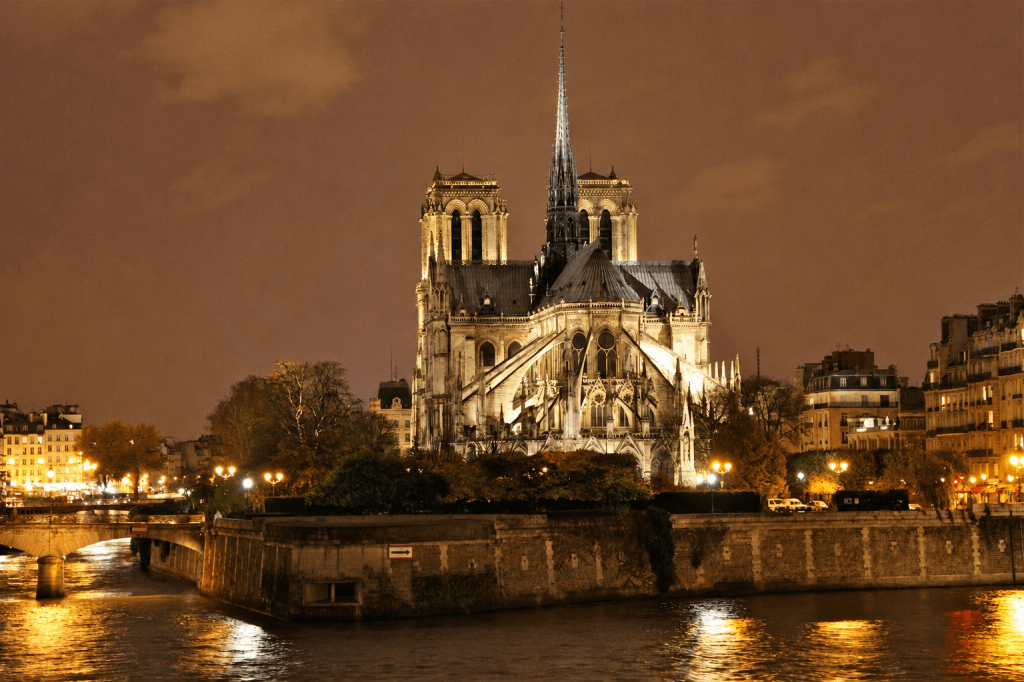
Address: 6 Parvis Notre-Dame – Place Jean-Paul II, 75004
Metro: Cité, Saint-Michel, Hôtel de Ville
During the day, Notre-Dame often feels less like a cathedral than a traffic pattern.
Thousands of visitors circulate through the square. Guides raise umbrellas. Cameras click. People queue, shuffle, photograph, and move on. The building becomes scenery for human activity.
Night reverses the equation.
The crowd thins. The noise drops. The western façade rises out of shadow like a limestone cliff. Details hidden by daylight suddenly emerge. The portals acquire depth. The towers become heavier. The entire structure feels older.
Not prettier, older. That distinction matters.
Many visitors arrive searching for atmosphere. Paris usually provides something more interesting than atmosphere. It provides evidence. Eight centuries of stone remain standing in the middle of one of the busiest cities on earth. The fact itself carries more weight than any ghost story.
A couple sits beneath the cathedral sharing a pistachio gelato. A priest crosses the square carrying a backpack. A municipal worker drags a hose across the pavement. Nobody appears particularly impressed by the building behind them.
Parisians rarely are, and that may be the most Parisian thing of all.
10:15 P.M. — Cross The River
Most visitors walk across Pont Saint-Louis because they are going somewhere. The better approach involves walking across because there is nowhere to go.
Île Saint-Louis remains one of the strangest pieces of real estate in Europe. It occupies the center of a capital city visited by tens of millions of people, yet somehow retains the energy of a place slightly detached from the surrounding machinery.
The island grows quieter as the evening progresses.
Residents walk dogs. Elderly couples return from dinner. Apartment windows glow above the quays. The smell of river water mixes with cigarette smoke and the lingering sweetness of ice cream from Berthillon.
Nothing much happens here. That’s the attraction.
Modern tourism trains people to seek stimulation every few minutes. Paris after dark rewards the opposite instinct. The city becomes more interesting when it stops trying to entertain.
The narrow streets around Quai d’Anjou and Quai de Bourbon feel almost stubbornly resistant to novelty. The façades remain old. The proportions remain human. The river remains close enough to hear.
Visitors searching for excitement often miss these places. Visitors searching for Paris usually don’t.
10:45 P.M. — Place Dauphine Gets Away With Murder
Not literally.
At least probably not.
Address: Place Dauphine, 75001
Metro: Pont Neuf
Place Dauphine feels like a clerical error in the urban planning records.
The square sits on some of the most valuable land in France, yet behaves like a forgotten village green. Millions of tourists pass within a few hundred feet each year. Many never find it.
By late evening, chestnut trees cast long shadows across the gravel. Someone reads a newspaper beneath a lamp. Two men play chess. A woman drinks white wine from a paper cup while pretending to work on a novel.
Perhaps she actually is. The square does something increasingly rare. It allows people to exist without demanding performance.
No monument requires photographing. No attraction requires ticketing. No queue requires joining. The place simply sits there in the middle of Paris refusing to monetize every second of attention.
Stay twenty minutes. Most visitors never do.
11:30 P.M. — The Catacombs Follow You

Address: 1 Avenue du Colonel Henri Rol-Tanguy, 75014
Metro: Denfert-Rochereau
The Catacombs closed hours ago. That hardly matters. Six million dead Parisians remain exactly where they were.
Earlier in the day, visitors descended into former limestone quarries and walked through galleries lined with human remains. Most emerge treating the experience like an attraction completed and checked off a list.
The Catacombs are not an attraction, they are context. The knowledge changes the city above them.
Standing outside Denfert-Rochereau at night, watching buses pass cafés and pharmacies, it becomes difficult not to think about what lies beneath the pavement. Paris begins feeling layered rather than flat. Every church acquires additional weight. Every apartment building gains another dimension.
Tourists frequently search for ghost stories. The reality is more unsettling.
An entirely ordinary city sits atop one of the largest ossuaries on earth. Nobody talks about it very much because everybody already knows.
You have to walk down 130 steps to see the spectacle of human remains, so try to take advantage of a priority time slot ticket so you don’t have to wait in a one-to-three-hour line beforehand. Save your patience for the descent.
Midnight — Dinner Is The Nightlife
American visitors often misunderstand Paris. They assume nightlife begins after dinner. Paris frequently disagrees.
8 Rue Grégoire de Tours, 75006
11 Rue des Canettes, 75006
Around midnight, occupied tables remain occupied.
A waiter carries another basket of bread. Someone orders one final glass and immediately begins considering a second final glass. Conversations drift from politics to literature to gossip and back again. The table next door has clearly been sitting there for hours and shows no signs of leaving.
Nobody seems concerned. This is not slow service, it is a fundamentally different understanding of time.
Many of the best nights in Paris involve a plate of Comté, a carafe of wine, a notebook, and absolutely no plan. The city excels at lingering. It treats lingering as a legitimate activity rather than a failure to optimize one’s evening.
That may sound minor. It is not.
1:15 A.M. — The Seine Belongs To The Stubborn

The river changes again after midnight.
Most tourists have disappeared. The influencers have gone home. The evening crowd has thinned into something more interesting.
Four students occupy a stretch of quay beneath Pont Louis-Philippe. They are sharing a bag of Monoprix salted chips, two bruised nectarines, and a bottle of rosé that lost its chill an hour ago. A cyclist rolls past carrying a towel from an evening swim. Someone nearby is discussing philosophy with the confidence usually reserved for people who have never studied it.
The reopening of the Seine Swimming changed this atmosphere.
Not dramatically, subtly. The river feels used now.
People argue about water quality. They compare swimming sites. They debate whether they would ever get in. The Seine no longer functions exclusively as scenery. It has become part of daily life again.
The change remains visible even after the swimmers leave.
2:15 A.M. — Châtelet Never Sleeps Properly
Metro: Châtelet–Les Halles
Most neighborhoods become quieter at night. Châtelet becomes stranger.
The station acts as a circulatory system for the entire region. Even after midnight, people continue arriving from somewhere and leaving for somewhere else. Night-shift workers pass tourists. Teenagers pass business travelers. A man carrying flowers passes a woman carrying a cello case.
Nobody seems connected. Everyone is.
This may be the closest Paris comes to revealing its machinery. The monuments disappear, but the transportation network remains.
3:20 A.M. — The Bakers Are Awake
At 3:20 a.m., the city starts preparing tomorrow.
A white Renault delivery van rattles up Rue des Martyrs. Lights glow behind bakery windows. Workers carry trays. Espresso machines hiss. Municipal cleaning crews wash yesterday’s cigarette butts and melted ice cream from the pavement.
The city no longer belongs to visitors, it belongs to workers. This is the shift change nobody photographs.
The people preparing breakfast have already started their day before most tourists have gone to bed.
Paris survives because of them, not because of monuments.
4:25 A.M. — Montmartre Before Montmartre

Montmartre at noon feels like a tourist attraction. Montmartre at 4:25 a.m. feels like a neighborhood. The distinction is enormous.
The portrait artists are asleep. The souvenir stalls remain shuttered. Place du Tertre sits empty. Delivery vans outnumber visitors.
For a brief period, the hill becomes visible beneath the commerce built around it. The steep streets feel steeper, the silence feels earned. This may be the most honest version of Montmartre available.
It doesn’t last long. By sunrise, the city begins selling the neighborhood again.
4:55 A.M. — Midnight Movies in the Park
If you stay awake long enough during the high summer weeks, you can catch the tail end of the city’s open-air cinema events. The Outdoor Cinema at La Villette rounds out the night for film lovers who prefer watching classic cinema under the stars, wrapping up just before dawn begins to break across the canal network. It serves as a reminder that the city’s artistic core doesn’t retreat indoors when the galleries lock up.
5:03 A.M. — Paris Changes Shifts
We began with one shift change, we end with another.
Bakery displays fill with croissants. Market deliveries arrive. Early commuters emerge from apartment buildings. The first tourists begin waking up and planning a day that will look remarkably different from the night that preceded it.
The Seine remains where it was, Notre-Dame remains where it was, the Catacombs remain where they were.
Only the people have changed. Travel guides often describe Paris as magic, but that suggests illusion.
Paris after dark is compelling precisely because it strips illusion away. The crowds thin. The sales pitch ends. The performance concludes. What remains is a large, complicated, beautiful, frustrating city occupied by people trying to live their lives.
The monuments still matter, the river still matters, the history surely still matters.
Yet somewhere between Notre-Dame at 9:37 p.m. and Montmartre at 4:25 a.m., another version of Paris emerges. Quieter. Stranger. Less interested in impressing anybody.
For people willing to stay awake long enough to meet it, that version is usually the one worth remembering.


Leave a Reply