The question shows up every June like it’s going to mean something. What is Fête de la Musique like in Paris?
It never lands cleanly. It can’t. The festival is too wide, too fractured, too many cities stacked on top of each other for a single description to hold. One block is a conservatory recital inside a stone courtyard that behaves like a soundproof box. Three streets over, a cargo bike is dragging a bass-heavy DJ set through a crowd that looks half awake and half feral. Both count. Both are official. Both are Paris.
So the better question is not what it is like. It’s which version of Paris are you entering.
Because on June 21, Paris stops being one city and becomes several overlapping systems of sound, each with its own rules of movement, etiquette, and noise tolerance. Some versions require stillness. Some require drift. Some require endurance more than taste.
The point of this guide is not to compress that into a summary. That would be dishonest. The point is to map the versions clearly enough that a decision becomes possible. Where to stand. What to avoid. When to leave. And what kind of night is actually being chosen, even if nobody admits they are choosing it.
Six versions follow. Each one is real. Each one runs at the same time.
1. The Institutional Listener — Paris as Controlled Resonance
This is the version of Paris that refuses mess. Sound is allowed in, but never allowed to sprawl. Everything is pre-shaped before it reaches the ear. Nothing is left to chance, and nothing is left uncontained.
At Radio France – Studio 104 (116 Avenue du Président Kennedy, 75016), programming typically runs on June 21 from early evening into late night (roughly 6:00 PM–11:00 PM), depending on broadcast scheduling. Entry is free but reservation-based, and tickets usually disappear quickly once released. Security is standard institutional fare—bag checks, limited standing movement, no late entry once sets begin. Inside, jazz ensembles and curated groups perform under suspended microphones that capture every breath before it becomes atmosphere. The room behaves like a recording first, a concert second.
Pro tip: arrive early even with a reservation. Late entry often means missing the first full set, and Studio 104’s sound balance changes noticeably once the room is fully occupied.
At Église de la Madeleine (Place de la Madeleine, 75008), choral and brass programming typically unfolds from late afternoon into evening (around 5:00 PM–9:30 PM) as part of Fête de la Musique church programming. Entry is free, but seating is first-come and limited. The stone interior does not amplify sound so much as reorganize it. Notes rise into the dome and return slower, heavier, softened by mass and height.
Pro tip: stand slightly off-center rather than directly under the dome. The vertical resonance is stronger there, and brass sections can become overwhelming if you’re directly beneath the main vault.
At Musée Eugène-Delacroix (6 Rue de Furstemberg, 75006), courtyard performances generally take place in the early evening window (around 6:00 PM–9:00 PM). Entry is usually free during special cultural nights, though museum access rules can vary depending on programming year. The courtyard is tight and enclosed, with ivy, stone, and geometry doing more acoustic work than any speaker system. Small ensembles—often conservatory strings or chamber formations—perform unamplified, producing sound that hits surfaces before it reaches the crowd.
Pro tip: avoid standing against the walls. Reflected sound here is delayed and can muddy harmonic clarity. The center of the courtyard has the cleanest acoustic reading.
At Institut du Monde Arabe (1 Rue des Fossés-Saint-Bernard, 75005), programming typically runs from late afternoon into night (about 5:00 PM–10:30 PM). Entry is often free for courtyard or terrace events, but some indoor performances may require timed tickets depending on the year’s schedule. The glass façade acts like a filter rather than a window. Sound, light, and movement are softened into layered geometry rather than released outward.
Pro tip: stay near the reflective edge of the courtyard rather than the center. The acoustic layering changes noticeably as sound bounces between glass and stone, and the edge gives a clearer separation between instruments.
This is Paris for listeners who want certainty more than surprise. Movement stays minimal. Conversations drop to half-volume. Even applause feels negotiated, like the room has set terms and expects compliance.
2. The Literary Drifter — Paris as conversational drift
Cross the Seine and the structure loosens without collapsing. Sound stops behaving like programming and starts behaving like overlap. Nothing locks into a single stage for long, and nothing stays fully contained once it begins.
At Place Saint-Michel (75005), activity typically unfolds from mid-afternoon into late evening (roughly 4:00 PM–11:30 PM) on June 21. There is no fixed stage layout. Sound arrives in competing fragments, each holding for a few minutes before dissolving into the next. A student choir from a conservatory often gathers near the fountain edge, running through unfinished harmonies that never fully lock into a single key. Nearby, a jazz duo—upright bass with visible wear on the fingerboard and a tenor sax pushed slightly past clean tone—sets up without ceremony. The sound competes directly with pedestrian crossing signals that click every thirty seconds, turning the intersection into an accidental metronome.
Pro tip: stand slightly off-axis from the fountain. Direct alignment pulls you into overlapping sound sources that blur detail. The edges of the square offer clearer separation between sets, especially when crowd density spikes after sunset.
The crowd here shifts continuously throughout the evening. Law students move in clusters with tote bags half-open, programs folded and refolded until the ink softens. Visiting academics pause mid-route as if mapping sound rather than geography. Writers occupy fixed positions for too long, half-reading paperbacks they will not finish because attention keeps breaking toward the next sonic interruption. Conversation behaves like background noise rather than structure, forming briefly in gaps between sets and collapsing the moment a new instrument takes over the air.
A short walk away, the atmosphere tightens at Palais-Royal (75001), where arcades and courtyards compress sound into deliberate geometry. Programming here typically runs from late afternoon into evening (around 5:00 PM–10:00 PM). Jazz ensembles and conservatory groups perform under colonnades that shape projection naturally, removing excess reverberation without digital control. Sets tend toward modal structures and restrained improvisation, with musicians leaving deliberate gaps between phrases rather than filling the acoustic space.
Pro tip: move deeper into the arcade rather than staying in the central courtyard. The colonnades create a natural acoustic filter, and mid-depth positions reveal detail that disappears in the open center.
This is not chaos and not order in any strict sense. It is interpretation shaped by architecture, foot traffic, and attention span. Music behaves less like performance and more like language that refuses to close its sentence.
3. The Aesthetic Wanderer — Paris as cinematic spill
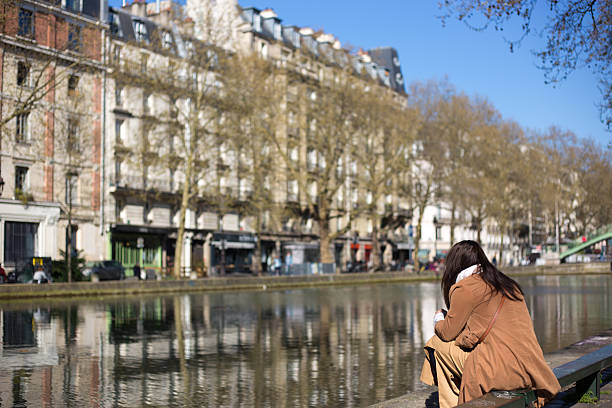
This is the version of Paris where sound stops respecting ownership. Nothing belongs to a stage. Nothing stays inside a venue. The city turns porous, and the Canal Saint-Martin becomes a long, slow spillway for whatever is loud enough to survive open air.
Along the canal, activity concentrates most reliably between late afternoon and midnight (roughly 4:00 PM–12:00 AM) on June 21. There is no ticketing system here. No entry point. The crowd forms as a consequence of weather, daylight, and whoever decided to bring a speaker that day. Portable rigs mounted on cargo bikes drift through pedestrian clusters. The music they carry is not curated in any formal sense: deep house edits, Afro-electronic cuts, slowed techno fragments. Everything bleeds into canal reflections and cigarette smoke that never quite clears in the humid air.
Pro tip: stay mobile. The sound field changes block by block, especially between Jaurès, République spillover, and the Saint-Martin bridge crossings. Standing still too long locks you into a mix that may already be fading two minutes later.
At La REcyclerie (83 Boulevard Ornano, 75018), programming typically runs from early afternoon into late evening (around 2:00 PM–10:30 PM) on Fête de la Musique. Entry is generally free for outdoor areas, with paid drinks and food service inside the rail-side venue. Built into a former railway station at Porte de Clignancourt, the space behaves less like a club and more like a daylight machine for sound. Afro-electronic, house, and experimental sets unfold without clean genre borders, often shifting mid-set without announcement.
Pro tip: arrive before sunset. Once the light drops behind the rail structure, the acoustics flatten and the crowd density doubles. The space becomes more congested, less readable.

At Le Hasard Ludique (128 Avenue de Saint-Ouen, 75018), programming usually stretches from late afternoon into night (roughly 5:00 PM–11:30 PM). Entry is typically free or low-cost depending on indoor access rules for the event, with outdoor rail-side activation forming the main listening zone. The long railway architecture channels sound horizontally rather than upward, so sets feel like they move laterally through the body of the space. Electronic, live hybrid, and experimental formats often shift without formal transitions, as if the structure itself refuses segmentation.
Pro tip: stand under the rail arches rather than in open courtyard zones. The arches carry bass differently, producing a tighter, more physical low-end response.
At Parc des Buttes-Chaumont (1 Rue Botzaris, 75019), particularly around Pavillon Puebla, programming tends to surface from late afternoon into late evening (around 4:00 PM–10:30 PM). Entry is free. The event structure is unstable by design. Label-driven sets and pop-up electronic programming appear in fragmented form rather than as scheduled shows. Cookie Records-style activations often behave less like concerts and more like weather systems that briefly settle over the park before moving on.
Pro tip: elevation matters here. The upper paths near the pavilion catch sound differently than the lower lake perimeter. Moving between levels changes the mix more than moving between artists.
This is Paris for people who do not attend events in a conventional sense. They drift through them. The city does the editing. The listener just follows what remains audible.
4. The Night System Participant — Paris as curated intensity
Along the Canal Saint-Martin, sound stops belonging to any single stage, or any single authority. It drifts with bodies, bikes, and late-day light that flattens reflections into liquid silver.
At Canal Saint-Martin, Fête de la Musique rarely behaves like a programmed event. Portable speakers strapped to cargo bikes cut through pedestrian clusters like moving punctuation. Deep house edits and Afro-electronic tracks spill out in uneven bursts, colliding with cigarette smoke and water reflections before dissolving into the canal’s slow current.
There is no official schedule here, but the strongest activity usually gathers from late afternoon into the late evening, roughly 5:00 PM to 11:30 PM. No tickets. No entry points. The only requirement is movement—standing still means losing the next sound source entirely.
The canal does not amplify music. It delays it, stretches it, returns it slightly wrong.
A short ride north, the tone shifts inside La REcyclerie (83 Boulevard Ornano, 75018), a former railway station at Porte de Clignancourt turned café-culture-venue hybrid. On June 21, programming typically starts in the mid-afternoon, around 2:00 PM to 4:00 PM, and runs into the late evening. Entry is generally free, though some workshops or special sets may require RSVP depending on this year’s lineup.
Here, DJ sets lean toward Afro-electronic, house, and experimental blends that never fully settle into genre identity. The courtyard fills early when the weather holds. Once capacity peaks, the experience becomes more sonic than visual. Pro tip: arrive before the main wave, or accept that you’ll be listening from the edges near the old rail fencing.
Further along the same railway spine sits Hasard Ludique (128 Avenue de Saint-Ouen, 75018), where sound travels horizontally under the old tracks instead of projecting outward. Programming on Fête de la Musique typically begins in the late afternoon and continues past midnight, moving between live bands, hybrid electronic sets, and DJ collectives without formal breaks.
There is no separation between stage and crowd here. People lean against metal beams that once carried freight. Drinks spill into ballast gravel. The sound moves along the structure like it still remembers it was built for transit.
South-east, the tone opens into foliage at Parc des Buttes-Chaumont, especially around Pavillon Puebla. Label takeovers and DJ collectives typically begin around 5:00 PM and continue until park restrictions tighten later in the night.
Here, sound behaves like weather rather than performance. A dense house set can flatten into ambient texture as it passes through trees. People move between grass slopes, stone bridges, and temporary bar setups, tracking clusters of sound rather than any fixed stage.
Practical note: schedules matter less than movement. The best sets are rarely found on arrival—they’re found by following density.
This is not Paris as a seated audience. It is Paris as drift logic. No fixed entry, no fixed exit, only fragments connected by motion.
5. The Mass Spectacle Body — Paris as density and pressure
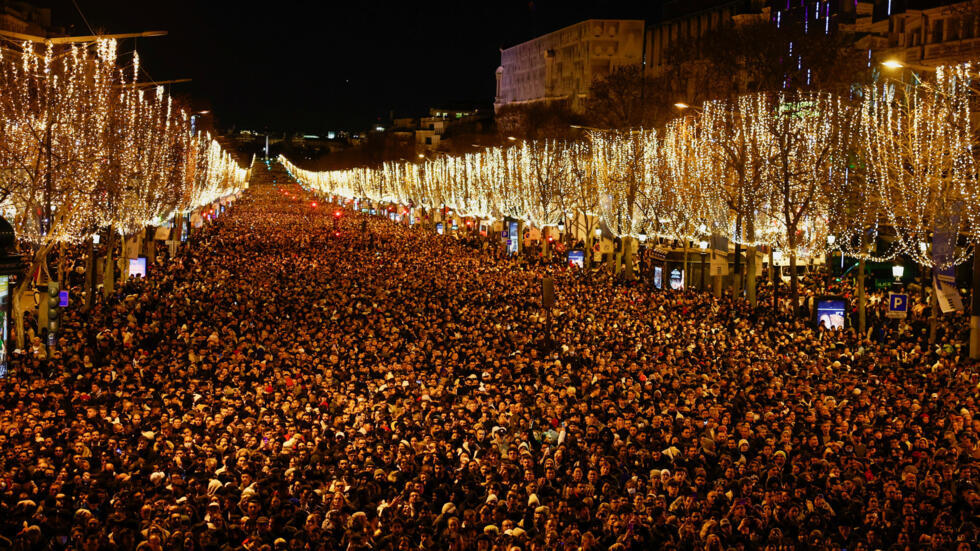
Some versions of Fête de la Musique don’t ask for taste, necessarily. They ask for endurance. Curation dissolves, and density takes over. The city stops presenting music as something to attend and starts producing it as something to withstand.
At Place de la République (75003), activity typically builds from late afternoon into late night (roughly 5:00 PM–12:30 AM) on June 21. There is no single stage in practice, even when official programming exists. Temporary sound systems appear along the square’s perimeter—stacked speaker towers, mobile DJ rigs mounted on vans, and small collective setups powered by portable generators. Bass-heavy sets rotate through different corners of the plaza, and the crowd reorganizes itself every few minutes in response. Movement is not optional here. It is structural. Standing still means becoming an obstacle.
Pro tip: avoid the center of the square. It becomes a compression zone after sunset where sound overlaps lose definition entirely. The edges near Boulevard du Temple and Rue du Faubourg du Temple offer slightly more navigable sound fields and faster exit routes toward quieter streets.

At Place de la Bastille (75004), the pattern intensifies. Programming generally runs from early evening into after midnight (around 6:00 PM–1:00 AM). Sound systems cluster near traffic islands and widened corners where circulation naturally bottlenecks. The Bastille column sits as a fixed reference point while everything else moves around it. People arrive in groups but rarely stay as groups. Density absorbs intent before it becomes action.
Pro tip: use the side streets—Rue de la Roquette and Rue de la Bastille—as pressure release valves. The square itself becomes increasingly difficult to exit directly after 10:30 PM, when pedestrian flow turns inward rather than outward.
Along the Seine, the logic shifts into linear drift. The river quays function as extended corridors of overlapping sound, typically active from late afternoon through late night (roughly 4:00 PM–12:00 AM). Speakers placed near bridges, embankments, and informal gathering points create echo chains that stretch sound along the water rather than across neighborhoods. The result is continuity without structure. People walk because gathering becomes secondary to movement, following whichever stretch of river currently carries the strongest low-end signal.
Pro tip: choose one bank and stay on it. Crossing bridges repeatedly increases exposure to overlapping zones where multiple sound systems collide and reduce clarity to pure pressure.
At Place du Châtelet (75001), institutional programming intersects with street saturation. Events here typically run from early evening into late night (around 6:00 PM–11:30 PM). The surrounding theatres and civic buildings host curated performances that spill outward into the square itself, erasing the boundary between stage and street reception. Sound behaves less like presentation and more like overflow from controlled interiors into uncontrolled exteriors.
Pro tip: position yourself slightly off the central axis between Théâtre du Châtelet and Théâtre de la Ville. Direct center positions lose definition quickly once crowds deepen after sunset.
At the largest scale, containment replaces drift entirely. At Paris Saint-Germain – Parc des Princes (24 Rue du Commandant Guilbaud, 75016), programming linked to Fête de la Musique typically runs from evening into late night (roughly 7:00 PM–midnight) depending on the year’s configuration. Entry is ticketed, with controlled access, security screening, and broadcast-grade production systems. Sound here does not spill. It is engineered to remain within boundaries designed for maximum intensity without diffusion.
Pro tip: treat this as a destination event, not a stop in a route. Transport planning matters more than timing, as post-event exit traffic toward Porte de Saint-Cloud and Michel-Ange-Molitor becomes heavily congested.
This is Paris at maximum occupancy. Not curated, not controlled. Just full.
6. The Exit Strategist — Paris after it stops trying to impress itself
After midnight, the city stops behaving like a program and starts behaving like residue. The architecture stays intact, but coordination disappears. Sound no longer assembles into zones. It breaks apart into leftovers that move without direction, carried by people who are either leaving or refusing to leave.
At Église de la Madeleine (75008), closures begin early by Fête de la Musique standards, typically around 10:30 PM–11:30 PM, depending on programming and security flow. Church courtyards clear in controlled waves rather than sudden dispersal, and the final sound—usually choral or brass—does not end so much as it gets absorbed into stone and traffic outside. If you’re inside during the final set, the exit pressure builds fast; leaving a few minutes before closure avoids the crush at the narrow thresholds near Madeleine metro (Lines 8, 12, 14).
At Place Vendôme (75001), a different kind of silence holds. After 11:00 PM onward, the square empties into a polished stillness defined by security patrols, taxis, and reflective façades that never participated in the noise. It functions less as an event space and more as a pressure release valve for the surrounding nightlife zones. This is one of the most reliable late-night reset points in central Paris when the rest of the city starts to overload.
Along the Canal Saint-Martin (75010), post-midnight circulation runs roughly 12:00 AM–2:00 AM, depending on remaining crowd density and transport flow. Groups thin unevenly, sitting along the edges near Boulevard Jules Ferry or drifting toward République once night buses become the dominant logic again. If you are still canal-side after midnight, movement toward Place de la République (75003) is the most efficient way out, since it concentrates night buses and metro access even after peak crowd hours.
In the Latin Quarter, fragments persist around Rue de la Huchette and Rue Saint-Séverin, where upper-floor apartments and small bars occasionally leak residual piano lines or delayed vocal phrases long after official programming has ended. It can feel active, but most venues here close between 12:00 AM and 2:00 AM, and lingering too long turns into drift without exit logic rather than continuation.
At the largest scale, circulation replaces experience. Deliveroo and Uber Eats riders re-enter the streets after midnight in greater numbers, moving along optimized routes between late kitchens, apartments, and metro nodes. Their insulated backpacks—usually black or dark green with reflective piping—cut through intersections that have already emptied of festival density. Movement becomes functional again, stripped of drift.
The night does not end cleanly. Paris simply stops aligning its sound, and what remains is what refuses to organize itself.